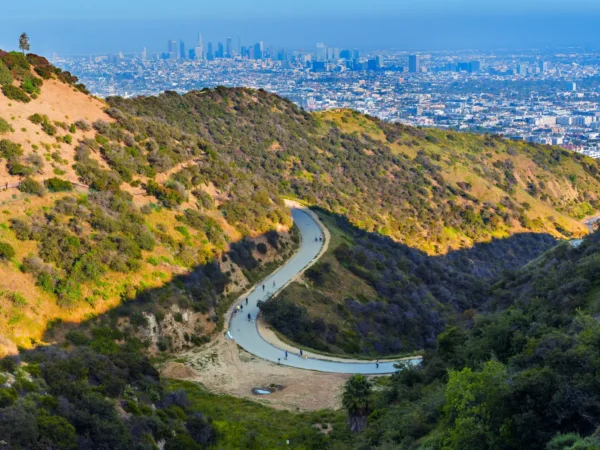
The trail, announced by the Mountains Recreation and Conservation Authority and highlighted this week by LAist, runs about three-quarters of a mile across MRCA-managed parcels at Elephant Hill. LAist reports that the route connects the area near Pullman Street and Harriman Avenue with Lathrop Street, using switchbacks to navigate the steep hillside terrain.
For local hikers, the opening matters because Elephant Hill has never been a typical developed city park. The 110-acre hilltop has long been used informally by neighbors, but access has been complicated by steep slopes, fragmented private ownership, dumping, off-road vehicle damage, and a decades-long conservation effort. The new trail does not turn Elephant Hill into a polished destination park; it creates a more legible public path through a landscape that community advocates have been trying to protect for years.
What we know
- Location: Elephant Hill Open Space in El Sereno, Northeast Los Angeles.
- Trail length: Approximately 0.75 miles, according to MRCA.
- Access point reported by LAist: Pullman Street and Harriman Avenue, with the route crossing toward Lathrop Street.
- Public hours reported by LAist: Daily from 7 a.m. to 5 p.m.
- Managing agency: Mountains Recreation and Conservation Authority, working with the Santa Monica Mountains Conservancy and Save Elephant Hill.
- Improvements: MRCA says the project includes trailhead fencing, signage, landscape boulders, drainage features, new native trees, and switchbacks.
MRCA describes the new route as the first official public-use trail specifically built for Elephant Hill in El Sereno. In its May announcement, the agency said the trail was funded through a $700,000 Los Angeles County Regional Park and Open Space District Proposition A grant. That grant also supported the acquisition of additional open-space parcels.
The agency also said Elephant Hill remains a complicated conservation project because much of the broader 110-acre natural area is divided among more than 200 non-contiguous private holdings. MRCA says it is continuing to acquire parcels and bring more of the hillside under public protection. The City of Los Angeles has also preserved 15 acres of the undeveloped hilltop, according to MRCA.
Why hikers should care
Elephant Hill is not a big-mileage mountain outing, but it is exactly the kind of neighborhood open space that matters in Los Angeles: close to homes, transit corridors, schools, and dense urban neighborhoods that have less easy access to parks than wealthier hillside communities. A short trail with views can be more useful to local residents than a remote wilderness route that requires an hour of driving.
The new path should also reduce some of the ambiguity around where people can walk. Informal use of urban hillsides often creates erosion, social trails, and conflicts with restoration work. A designated route gives hikers a better option while helping land managers focus restoration and patrol efforts.
That said, visitors should treat Elephant Hill as a developing conservation area, not a fully built-out recreation complex. Expect exposed terrain, limited shade, neighborhood access, and a short route rather than a long backcountry hike. Go during posted hours, stay on the official path, pack out trash, keep dogs under control where allowed, and avoid cutting switchbacks or entering parcels that are not clearly open to the public.
Conservation context
Save Elephant Hill, a community organization that has worked for years to protect the area from development and damage, called the trail a safer and more enjoyable way for the public to hike, bird, and explore the MRCA-managed parkland. MRCA also credited Save Elephant Hill, the Santa Monica Mountains Conservancy, Los Angeles Conservation Corps, and other partners with helping move the project forward.
MRCA says recent investments include Proposition 68 grants from the Santa Monica Mountains Conservancy for land acquisition, a Proposition 4 grant to Save Elephant Hill for community-centered conservation planning, and funding for patrols, gates, signage, and barriers aimed at addressing off-road vehicle impacts and other ongoing challenges.
For LA hikers, the takeaway is simple: Elephant Hill now has a more formal public trail, but its long-term future still depends on careful use, continued acquisitions, restoration, and neighborhood stewardship.