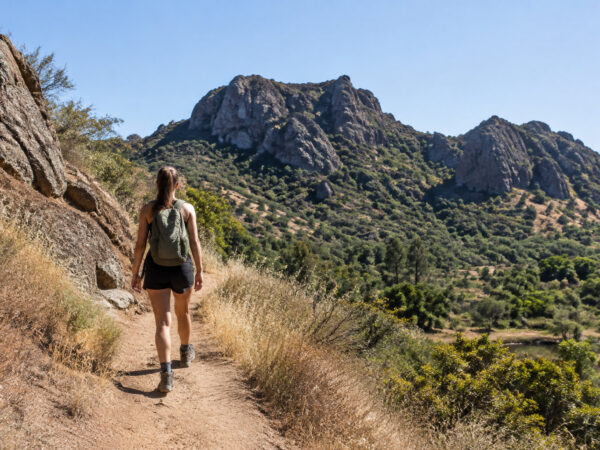
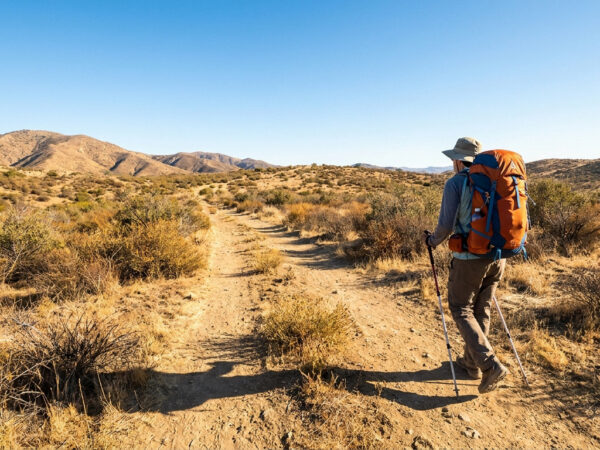
Spring is the main wildflower season in the Santa Monica Mountains. But rain can shift the bloom from one year to the next.
The hard part is knowing which trails to pick and when to go. This article shows you which areas and trails have the densest blooms, and how to reach them.
Wildflowers in the Santa Monica Mountains: where the blooms cluster
Topanga State Park and the Musch Ranch loop
Topanga State Park has the largest trail network in the range. For the densest spring blooms, hike the Musch Ranch loop, about 3.5 miles (5.6 km).
Park at the Trippet Ranch lot, which gives access to the Musch Ranch Trail. To reach the park, follow Entrada Road to the entrance. For more hikes in the range, see other underrated LA hiking options.
Malibu Creek State Park
If you want shade and water, head to Malibu Creek State Park. Its trails run along the creek for 15 miles, out of a 37-mile network in the park. On those creek trails, you walk beside the water.
Cheeseboro and Palo Comado canyons
Cheeseboro and Palo Comado mix habitats. The China Flat sector has a loop toward Modelo Trail: 3 miles (about 4.8 km) round trip.
It crosses oak savanna before climbing a ridge. Reach it by Chesebro Road. The main lot opens at 8 a.m. and closes at sunset.
Point Mugu State Park and La Jolla Valley
Two areas, two different trips.
| Point Mugu State Park | La Jolla Valley | |
|---|---|---|
| Size | Over 60 miles of trails | A grassy plain |
| Terrain | Trail network | Plain ringed by mountains |
| Best for | Long days, many loops | Spring walk to see flowers |
The roads between these areas are long and winding, so switching zones eats up hours of driving. Pick one zone per visit and spend your time on its trails.
Easy walks at Satwiwa and Zuma Canyon
Satwiwa is the easiest pick. Its 1.5-mile round-trip loop (about 2.4 km) stays flat through meadows and chaparral, so it suits families. Parking is free, open 8 a.m. to sunset, with restrooms and water fountains nearby.
Zuma Canyon’s 2-mile loop follows the canyon floor under sycamores, oaks and black walnuts, so it stays shaded. Park at the end of Bonsall Drive, reached via Busch Drive and Rainsford Place. For a waterfall, see Escondido Falls hike.
Zuma Canyon parking
Facilities
The lot has restrooms and a water tap.
Dogs
Keep your dog on a leash of 6 feet at most, about 1.8 m.
Arrive early for a quieter walk.
Circle X Ranch and Arroyo Sequit for quieter meadows, the Backbone for distance
Circle X Ranch is the quieter choice. The Mishe Mokwa trail to Split Rock runs 3.5 miles round trip (about 5.6 km), and its oak grove gives shade.
Take Mulholland Highway inland from Pacific Coast Highway, then drive 6 miles to the entrance. The lot fits five cars. For a second stop nearby, see Las Virgenes View Park.
Hike the Backbone Trail in sections:
- One section per day: it runs 65 miles one way.
- Go in late winter or early spring.
- Cooler then, and plants are green and blooming.
The site is closed until further notice. Check its status before you drive there, or you may make the trip for nothing.
The flowers to expect, trail by trail
Look for California poppies, lupines, Parry’s phacelia, wild peas, canyon sunflowers, morning glory, owl’s clover, wild hyacinth and Mariposa lilies. Most flower at their peak in March and April.

Spring brings California poppies, lupines and Mariposa lilies to the open slopes and meadows. Look for them on sunny ground, where they get full light all day long.
The Cheeseboro oak grassland lies along Cheeseboro Canyon Trail. The 3-mile loop to Modelo Trail crosses it before climbing to a ridge, so the grassland comes early in the hike.
A long season, one example
What bloomed
- California poppies
- Phacelia
- Mariposa lilies
- Canyon sunflowers
A one-off
- Not a benchmark for other springs.
Peak bloom falls in March and April, but rain can shift it
Peak bloom usually falls in March and April, but that is a pattern, not a promise. Rain can shift it, so treat the window as a guide. For spring color in one valley, see La Jolla Valley trails.
Rain moves the peak. Late rains once raised hopes of a bloom in mid or late April. In a much wetter season, Cheeseboro Ranch logged 14.17 inches, against 1.95 the year before, and the flowers lasted longer.
Check before you choose
Without checking
- Choose a trail from a map alone
- Find out on the spot that the flowers are elsewhere
With What’s Blooming
- Read the news on where to look for flowers
- Pick your trail after reading it
How to tell native blooms from black mustard
Don’t assume a yellow hillside is native. Black mustard is invasive: after heavy rain it can cover hills in bright yellow, push out local plants, and help fires spread.
Before naming a yellow flower, check it on site:
- Look for several kinds of flowers together.
- Check the leaves and petals in a plant guide.
- Compare it with California poppy or mariposa lily.
A mix of different flowers points to a native bloom, even with mustard nearby. Mustard usually forms a solid yellow patch.
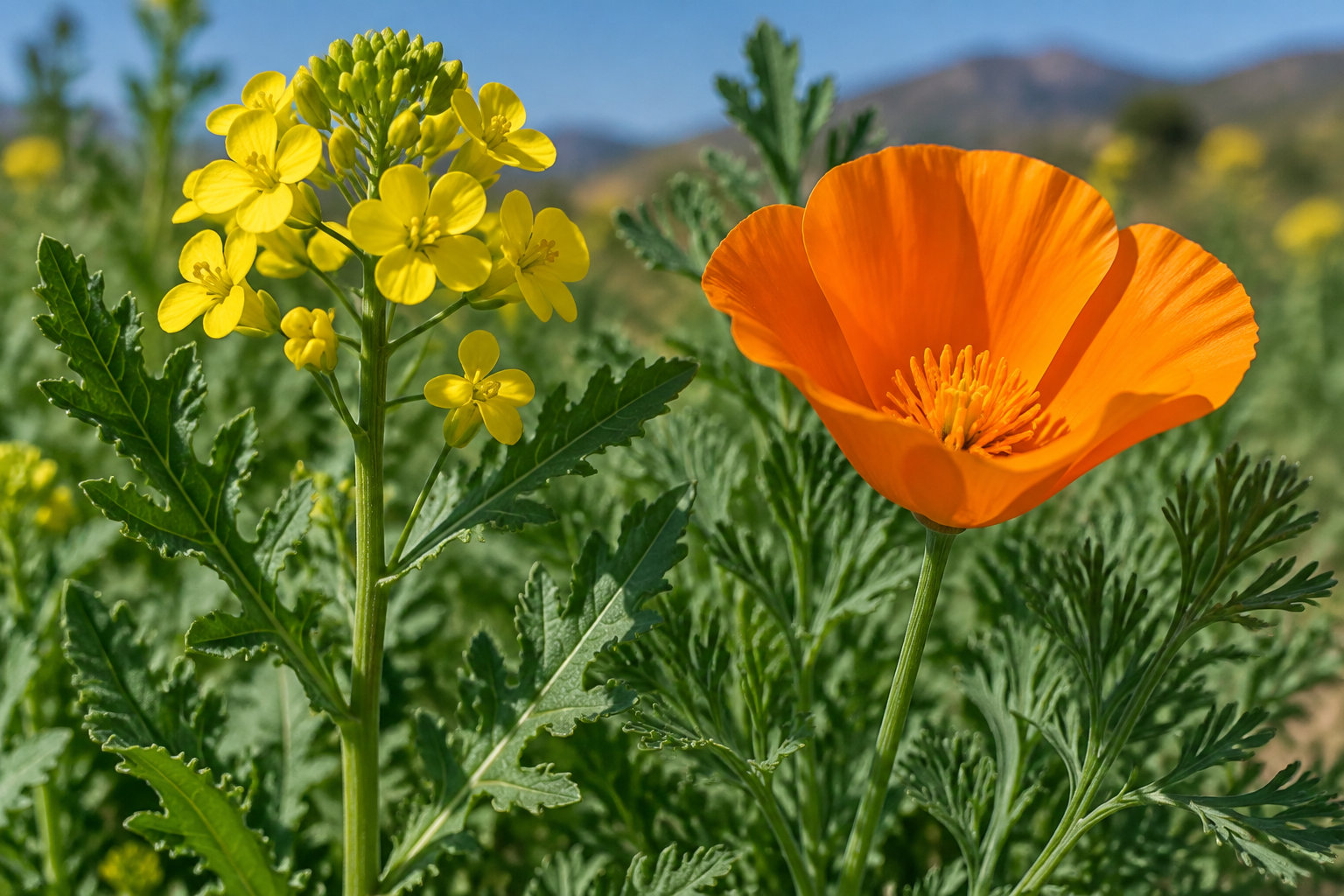
Native or mustard?
What works
Several kinds of flowers mixed together.
What to avoid
One solid yellow patch on the slope.
What works
Check the leaves in a plant guide.
What to avoid
Naming it from a distance.
Access, fees and the rules that protect the flowers
Before you leave, call the visitor center at 805-370-2301 to check trail and parking closures. Rain can make trails dangerous, so ask about trail conditions too.
Parking costs and hours:
- Point Mugu day rate: $12 per car.
- Point Mugu hourly: $3 for one hour, $9 for three hours.
- La Jolla Canyon lots: open 8 a.m. to sunset.
Dogs are allowed in Point Mugu’s day-use areas and campgrounds, but not on its trails, backcountry included. At Satwiwa, keep them on a leash and on the trails.
Before you hike
- Stay on the trail.
- Don’t step on the plants beside it.
- Leave every flower where it grows.
- Don’t pick wildflowers in the parks, even one stem.
Spring is the best time for wildflowers, but rain sets the exact timing. Pick one zone for your visit, and choose the trail that fits how long you want to walk.
Before you leave, call the visitor center to check closures and trail conditions. Then stay on the trail and leave every flower where it grows.
Frequently asked questions
Are dogs allowed on the trails where wildflowers grow in the Santa Monica Mountains?
Not everywhere: dogs are not allowed on the trails in Point Mugu, so leave your dog at home for a flower walk there.
At Zuma Canyon, dogs can use the trails, but they must stay on a leash. Check each park before you go.
Is the Musch Ranch loop in Topanga State Park suitable for young children?
Only if your child can walk that far. The Musch Ranch loop is about 3.5 miles, so choose it for a child who already handles long walks, and pick a shorter hike for a child who tires fast.
Can the Backbone Trail be hiked in a single day?
No, not as one outing. The Backbone Trail runs 65 miles one way, so you hike it in sections on separate trips. Pick a stretch that fits your day, and save the rest for another visit.
Do wildflowers bloom in fall in the Santa Monica Mountains?
Yes, but only a few. Some flowers can still be out outside the spring peak, and what you find depends on the rain and the weather that year. For a full display, spring is still the time to go.